Read It Yourself: The Plan, Highlighted.
The most common reader response to last week's article was some version of: "I read the Comprehensive Plan. It does not say any of what you are claiming." That is a fair challenge. The right response is not more arguing. The right response is the document itself.
"I read the Plan myself. It says nothing of the sort. You are making this up."
We have heard that comment, in different forms, from neighbors, from readers, and from people who have decided we are not telling them the truth. They are reading the document, looking for the words we used, not finding them in the form they expected, and concluding the criticism is fabricated.
So we are doing the simplest thing we can do: we are publishing the relevant pages of the Plan, with the relevant rows highlighted in the Plan's own Implementation Table. The recommendations are from Chapter 4 (Main Street Revitalization) and Chapter 5 (Zoning and Land Use), as set out in the Plan's Implementation Table on pages 40–43. The Action numbers, the priority labels, and the responsible parties are reproduced exactly as they appear in the document. Read them yourself. Then decide.
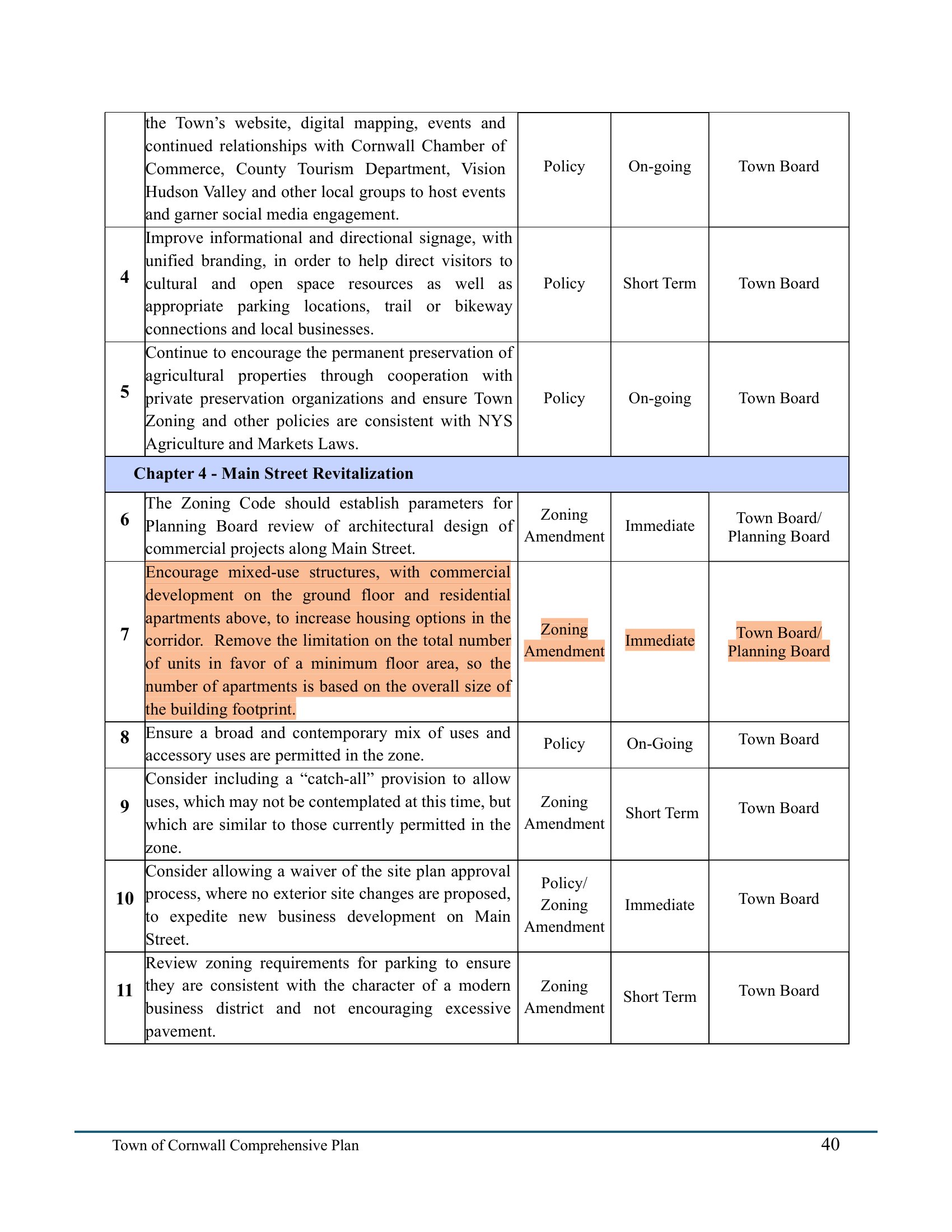
Action #7: The Apartment Cap on Main Street, Removed
The existing two-unit cap on apartments above commercial buildings on Main Street is removed. In its place, the Plan substitutes a floor-area formula — meaning the maximum number of apartments above any commercial parcel becomes a function of the building's footprint, not a fixed number. The Plan does not propose a replacement cap.
Actions #18 and #20: Single-Family + HC Zone
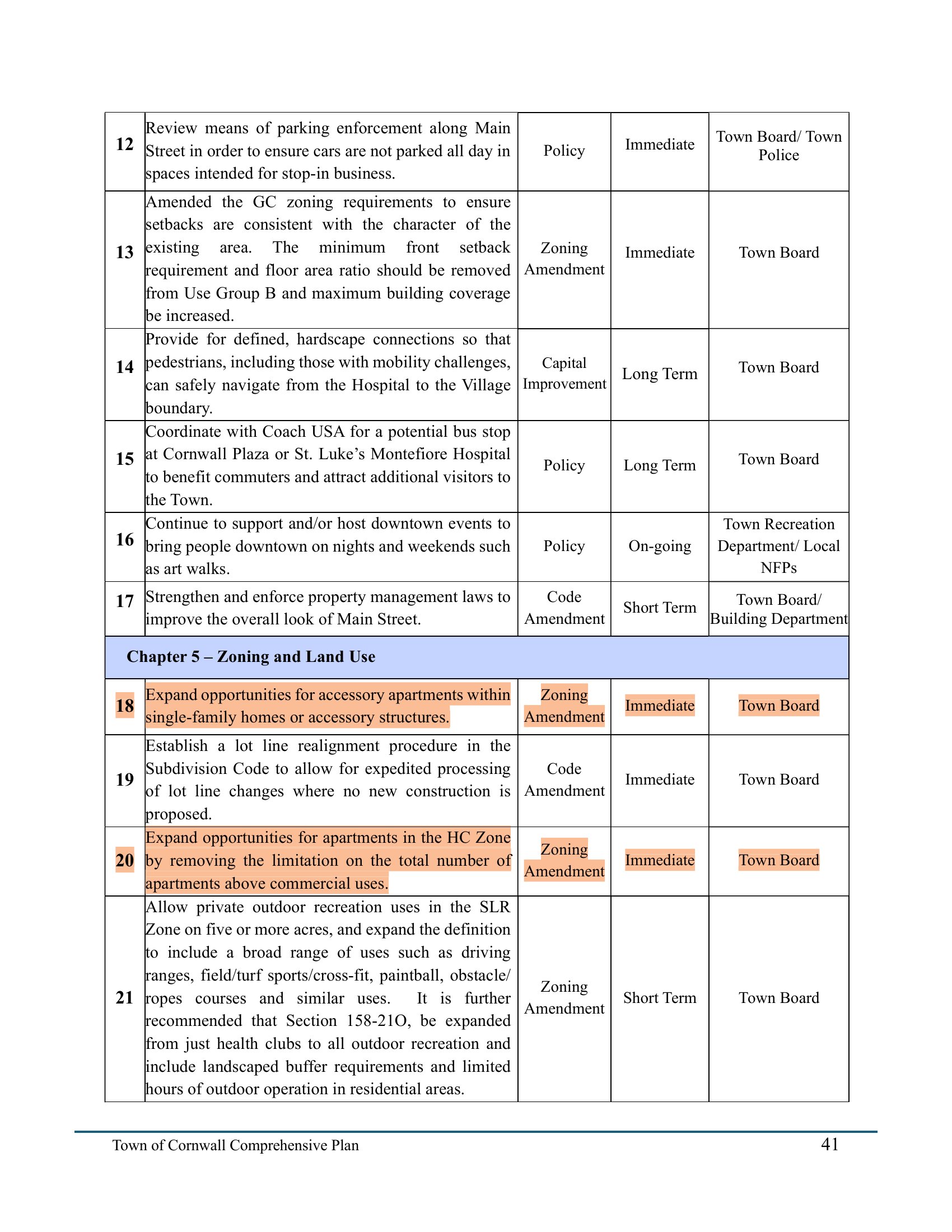
This page contains two of the most consequential housing recommendations in the Plan. Both are tagged Immediate priority. Both are highlighted below.
Accessory apartments are permitted on any single-family lot in town. Cornwall has thousands of single-family lots. The recommendation does not specify any standards — no size cap, no setback, no owner-occupancy requirement, no rental restrictions, no parking minimum. Those rules are deferred to a future code amendment that the Town Board will write only after the Plan is adopted.
The same apartment cap removal Main Street gets in Action #7 is applied to the HC Zone — the larger Highway Commercial corridor running along Route 9W and Route 32. No replacement numerical cap is proposed. The number of apartments above any HC commercial parcel becomes a function of building footprint alone.
Actions #25, #27, and #30: Three Changes, Same Page
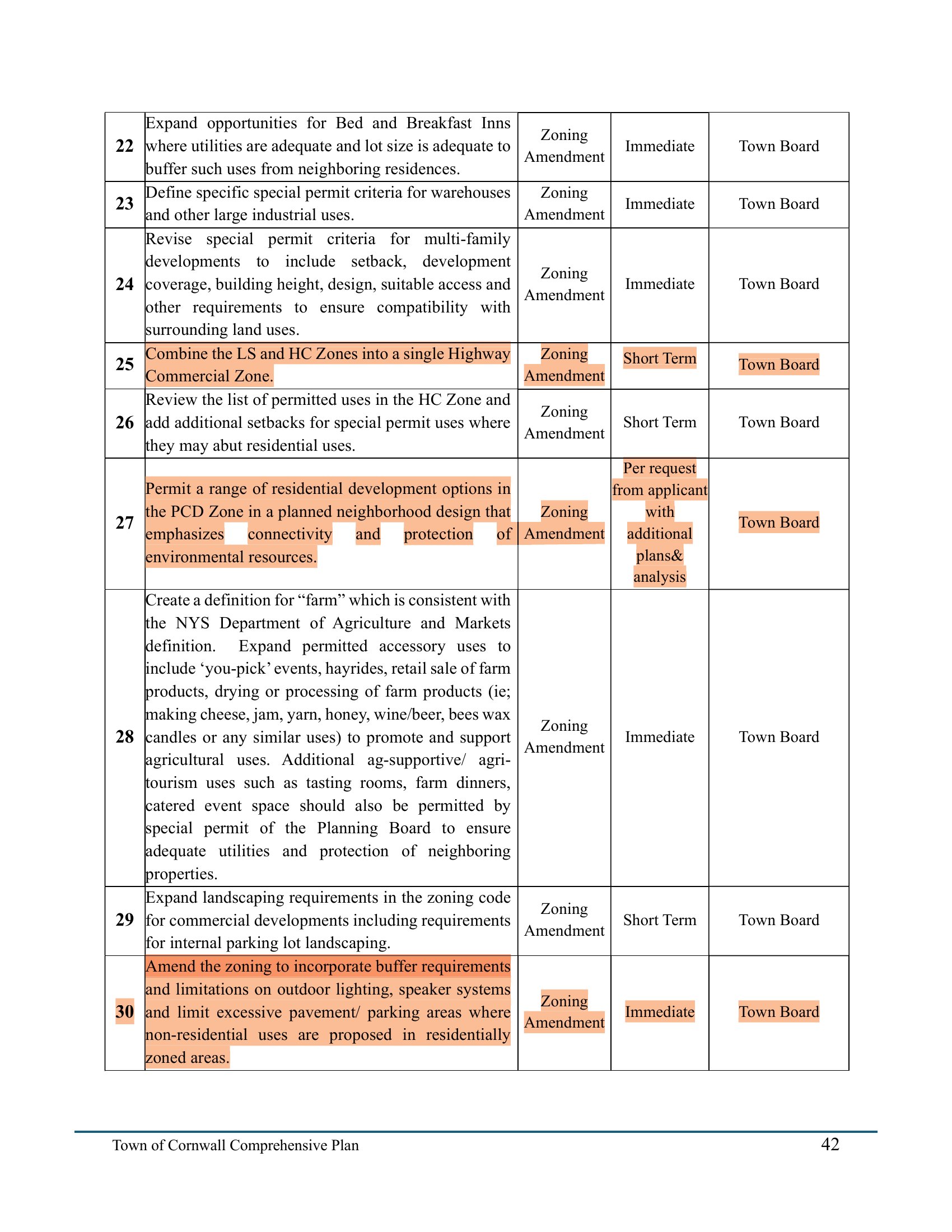
This is the page critics should read first. Three highlighted rows on the same page change three different things at once. None of them is a small adjustment.
The LS Zone (Limited Service) and the HC Zone (Highway Commercial) are merged into a single, larger Highway Commercial Zone. The combined zone is the same one where Action #20 removes the apartment cap. The result is that the cap-removal applies to a bigger geographic area than it would have under the existing zoning.
The Planned Commercial Development (PCD) zone is opened to "a range of residential development options." The trigger for this change is not the Town deciding to do it. The trigger is an applicant requesting it. The Plan's own priority column says so.
The Plan does not propose to keep non-residential uses out of residentially-zoned areas. It proposes to normalize them — accepting that they will be there, and adding cosmetic buffer requirements (lighting limits, landscaped setbacks) to soften the visual impact. The buffers do not prevent the use; they only dress it up.
Action #33: NYMA's Custom Modifications
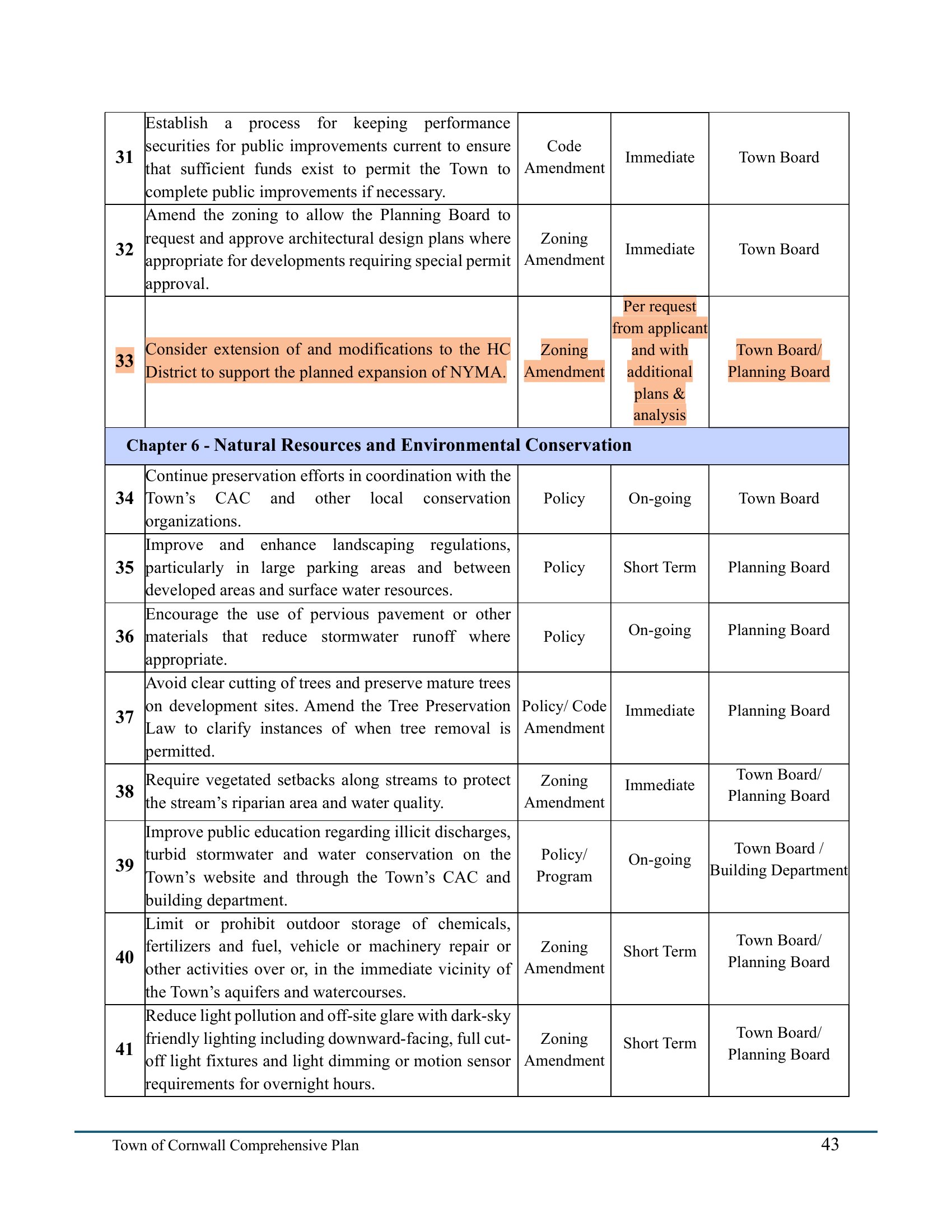
A specific 197-acre parcel — NYMA's campus — gets its own custom-tailored zoning provision in the Plan. Combined with the apartment-cap removal in HC (Action #20) and the LS+HC merger (Action #25), the 197-acre parcel ends up in a zone with no apartment cap and an expanded permitted-uses list. The trigger for the NYMA-specific change is the applicant, not the Town.
The Document and the Criticism Are Saying the Same Thing
This is the document. These are the recommendations. Each one is a row in the Plan's own Implementation Table. The recommendations come from Chapter 4 (Main Street Revitalization) and Chapter 5 (Zoning and Land Use), set out on Implementation Table pages 40–43. The priority labels — Immediate, Short Term, Per request — are in the Plan's own priority column. We did not paraphrase them. We did not invent them. We highlighted them.
If anyone tells you these provisions are not in the Plan, ask them to point to the page that contradicts what is highlighted above. The Plan does not contradict itself. It commits to these recommendations on the same pages it lists them.
Send this page to the neighbor who told you the fears were fabricated. Send it to the friend who said "well, I haven't read the Plan, but I trust them." Send it to the Town Board member who told you the criticism was unfounded. Then ask: which row do you disagree with, and on what page does the Plan disagree with itself?
Save Cornwall.
Don't let us become Palm Tree.
⚠ Before the Board Votes
The Town Board has scheduled the public hearing for May. Adoption is targeted for June or July. Written public comments are accepted at any time before adoption.
Bring this page with you. Bring the Plan with you. The pages and the Action numbers are the same in both documents.
Read the full draft at cornwallny.gov · Highlighted recommendations are from Chapter 4 (Main Street) and Chapter 5 (Zoning and Land Use), Implementation Table pp. 40–43.
All highlighted images on this page are direct screenshots of the Town of Cornwall Comprehensive Plan Update 2025, draft last revised January 27, 2026, Chapter 4 (Main Street Revitalization) and Chapter 5 (Zoning and Land Use), as set out in the Plan's Implementation Table on pages 40–43. Highlighting added by Cornwall Truth. The text quoted in each "What the Plan says, verbatim" block is reproduced word-for-word from the corresponding Action row in the Implementation Table. No edits, no condensations, no paraphrases. Where the Plan says Per request from applicant, this page says Per request from applicant. Where the Plan says Immediate, this page says Immediate. Read both side by side.